
Pneumatic control valves are critical devices used in modern industrial automation systems to regulate the flow of liquids, gases, steam, and other process media. These valves help industries maintain stable operating conditions, improve production efficiency, and ensure process safety. From oil refineries and chemical plants to water treatment facilities and power stations, pneumatic control valves are widely used in applications requiring precise flow regulation and reliable automated performance.
Unlike simple shut-off valves that operate only in fully open or fully closed positions, pneumatic control valves are designed for continuous modulation. They can adjust valve opening gradually and accurately in response to process requirements. By using compressed air as the driving force, these valves achieve smooth and responsive control over important process variables such as pressure, temperature, liquid level, and flow rate.
Pneumatic control valves are highly valued because of their fast response speed, durability, simplicity, and ability to operate safely in hazardous environments. Since compressed air is used instead of direct electrical power at the actuator, pneumatic systems are especially suitable for explosive or flammable industrial locations.
This article explores the operating principles of pneumatic control valves, their major components, valve configurations, working mechanisms, industrial applications, maintenance practices, and future technological developments.

A pneumatic control valve is an automatic valve that uses compressed air to position the valve mechanism and regulate fluid flow within a piping system. It receives signals from a controller and continuously adjusts its opening to maintain desired process conditions.
In industrial automation, pneumatic control valves are typically installed as part of a closed-loop control system. Sensors monitor process conditions and send information to a controller. The controller compares the measured value with the target setpoint and sends a corrective signal to the valve. The pneumatic actuator then adjusts the valve position accordingly.
The ability to regulate flow precisely makes pneumatic control valves essential in industries where accurate process control is required for safety, efficiency, and product quality.
The valve body is the main pressure-containing structure that directs process fluid through the valve. It houses the internal trim components responsible for regulating flow.
Valve bodies are available in different configurations, including:
- Globe valves
- Ball valves
- Butterfly valves
- Angle valves
Material selection depends on operating conditions such as pressure, temperature, corrosion resistance, and fluid compatibility. Common materials include carbon steel, stainless steel, duplex stainless steel, bronze alloys, and specialized corrosion-resistant alloys.
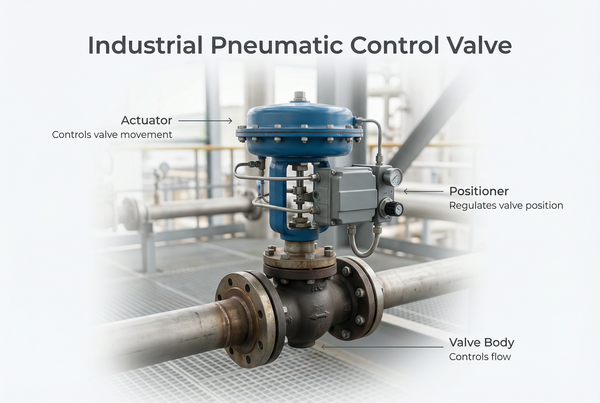
The pneumatic actuator converts compressed air energy into mechanical movement that operates the valve.
The actuator controls valve opening and closing according to the air pressure supplied by the control system.
Diaphragm actuators use a flexible diaphragm combined with a spring mechanism. Air pressure applied to the diaphragm creates movement that positions the valve stem.
Advantages include:
- Simple design
- Quick response
- Reliable operation
- Easy maintenance
Diaphragm actuators are commonly used in medium-duty industrial applications.
Piston actuators use compressed air to move a piston within a cylinder.
They are designed for applications requiring:
- High operating force
- Large valve sizes
- High-pressure service
- Heavy-duty industrial operation
Rotary actuators produce rotational motion and are commonly used with quarter-turn valves such as ball valves and butterfly valves.
These actuators offer compact construction and efficient operation.
The valve positioner ensures accurate valve positioning by comparing the control signal with the actual valve position.
If the actual valve position differs from the desired position, the positioner adjusts the air pressure supplied to the actuator until the correct valve position is achieved.
Positioners improve:
- Control accuracy
- Stability
- Response time
- Repeatability
Modern smart positioners also provide digital communication and advanced diagnostic functions.
An I/P converter changes electrical signals into pneumatic pressure signals.
Most process control systems operate using electrical signals such as 4–20 mA. The I/P converter transforms these signals into proportional pneumatic output pressures, typically ranging from 3–15 psi.
This pneumatic signal is then used to operate the actuator.
Valve trim refers to the internal flow-controlling components inside the valve body.
Trim components may include:
- Valve plug
- Seat
- Cage
- Disc
- Ball
- Stem
Trim design directly affects:
- Flow characteristics
- Noise levels
- Cavitation resistance
- Sealing performance
- Valve durability
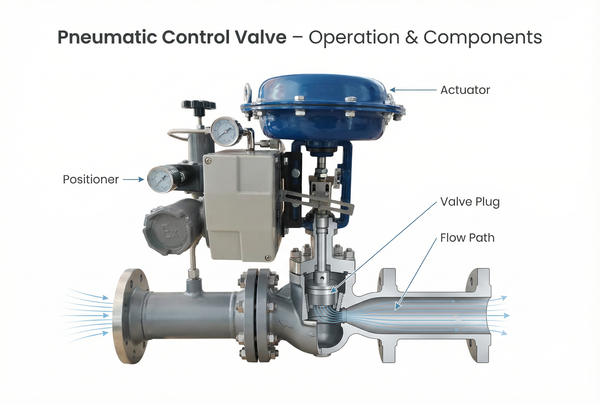
The operation of a pneumatic control valve involves several coordinated steps that enable automatic process regulation.
Sensors installed in the process continuously measure operating conditions such as:
- Pressure
- Temperature
- Flow rate
- Tank level
These measurements are transmitted to the control system.
The controller compares the measured process value with the desired setpoint.
If a deviation occurs, the controller determines how much the valve position must change to correct the process condition.
For example:
- If pressure rises above the setpoint, the valve may partially close.
- If flow decreases below the required level, the valve may open further.
The controller sends an electrical control signal to the I/P converter or smart positioner.
Most industrial systems use a 4–20 mA signal standard.
The I/P converter transforms the electrical signal into a proportional pneumatic pressure signal.
This pressure is directed to the actuator chamber.
Compressed air acts on the actuator diaphragm or piston, creating mechanical motion.
The actuator then moves the valve stem or shaft.
Movement of the valve trim changes the size of the flow passage inside the valve body.
This adjustment increases or decreases fluid flow until the process variable reaches the desired value.
The valve continuously modulates its position to maintain stable process control.
Safety is extremely important in industrial process systems. Pneumatic control valves are often designed with fail-safe functions that determine valve position during loss of air pressure or system failure.
Fail-closed valves automatically close when air pressure is lost.
These valves are commonly used in applications where stopping flow improves safety, including:
- Fuel gas systems
- Chemical pipelines
- Hazardous fluid handling
Fail-open valves automatically move to the open position during air failure.
These valves are used where continuous flow is necessary for equipment protection or emergency operation.
Examples include:
- Cooling water systems
- Emergency vent lines
Some systems require the valve to remain in its last operating position during failure conditions.
This function can be achieved using locking devices or air reservoir systems.
Globe valves are widely used for precise throttling control.
Advantages include:
- Excellent flow regulation
- Stable operation
- High control accuracy
They are commonly used in:
- Steam systems
- Chemical plants
- Power generation facilities
Ball valves use a rotating ball with a central bore to regulate flow.
Advantages include:
- Tight shutoff
- Low pressure drop
- Fast operation
Ball valves are commonly found in:
- Oil and gas systems
- Water treatment facilities
- Slurry applications
Butterfly valves use a rotating disc to control flow.
Advantages include:
- Compact design
- Lightweight construction
- Lower installation cost
They are ideal for:
- Large-diameter pipelines
- HVAC systems
- Water distribution systems
Angle valves feature a 90-degree flow path and are designed for severe service applications involving:
- High pressure drops
- Flashing
- Cavitation
- Erosive fluids
Directional pneumatic valves can be classified according to their design characteristics.
Ports are the openings through which compressed air enters or exits the valve.
Common configurations include:
- 2-way valves
- 3-way valves
- 4-way valves
- 5-way valves
Directional valves may operate with:
- Two positions
- Three positions
The number of positions determines airflow routing options.
These valves remain closed when no control signal is applied.
Airflow begins only when the valve is actuated.
These valves remain open when not actuated and close when a control signal is applied.
The flow characteristic describes how valve flow changes relative to valve travel.
Linear Characteristic
Flow changes proportionally with valve movement.
This characteristic is suitable for systems with constant pressure drop.
Equal Percentage Characteristic
Each increment of valve travel produces an equal percentage change in flow.
This characteristic provides stable control over a wide operating range and is widely used in industrial applications.
Quick Opening Characteristic
A small valve movement creates a large increase in flow.
Quick opening valves are mainly used for on/off service.
Fast Response Speed
Pneumatic actuators react quickly to changing process conditions, allowing rapid system adjustment.
Intrinsic Safety
Compressed air operation reduces the risk of electrical sparks, making pneumatic valves suitable for hazardous environments.
Reliable Performance
Pneumatic control valves provide dependable operation in harsh industrial conditions.
High Operating Force
Pneumatic actuators can generate significant force for operating large valves under high pressure.
Low Maintenance Requirements
Pneumatic systems have relatively simple mechanical structures that are easy to maintain.
Excellent Durability
These valves can tolerate:
- High temperatures
- Dust
- Moisture
- Corrosive environments
- Heavy vibration
Oil and Gas Industry
Pneumatic control valves regulate:
- Crude oil flow
- Natural gas distribution
- Refinery operations
- Pipeline pressure
Chemical Processing Industry
Chemical plants use pneumatic valves to control reaction conditions and maintain safe process operation.
Power Generation
Applications include:
- Steam flow regulation
- Boiler feedwater control
- Cooling systems
- Turbine operation
Water and Wastewater Treatment
Pneumatic valves are widely used in:
- Filtration systems
- Chemical dosing
- Sludge handling
- Water distribution networks
Food and Beverage Processing
Sanitary pneumatic valves help maintain hygiene standards while ensuring accurate process control.
Pharmaceutical Manufacturing
Precise flow control is essential for maintaining product consistency and regulatory compliance.
Mining and Metallurgy
Heavy-duty pneumatic valves handle abrasive slurries and severe operating conditions.
Poor Air Quality
Contaminated compressed air containing moisture, oil, or dirt can damage actuators and positioners.
Proper filtration and drying systems are necessary.
Valve Stiction
Excessive friction between moving components may prevent smooth valve movement.
Stiction can reduce control accuracy and create unstable operation.
Cavitation
Cavitation occurs when pressure drops below vapor pressure, causing vapor bubbles to form and collapse violently.
This can result in:
- Noise
- Vibration
- Severe trim erosion
- Flashing
Flashing occurs when liquid changes permanently into vapor after passing through the valve.
This condition may damage valve trim surfaces.
Leakage
Worn seats or damaged seals may cause internal or external leakage.
Routine maintenance is essential to prevent leakage problems.
Proper maintenance improves reliability, safety, and service life.
Routine Inspection
Operators should regularly inspect:
- Air supply systems
- Actuators
- Positioners
- Valve packing
- Seals and gaskets
Calibration
Positioners and controllers should be calibrated periodically to ensure accurate valve response.
Lubrication
Proper lubrication reduces friction and minimizes wear of moving parts.
Air System Maintenance
Compressed air systems should include:
- Air filters
- Air dryers
- Pressure regulators
Clean air significantly improves valve performance.
Trim Replacement
Valve trim components may require replacement due to erosion, corrosion, or mechanical wear.
Modern automation systems increasingly use intelligent pneumatic control valves equipped with digital technologies.
Smart valves can provide:
- Remote monitoring
- Real-time diagnostics
- Predictive maintenance
- Performance analysis
- Digital communication
Common communication protocols include:
- HART
- FOUNDATION Fieldbus
- PROFIBUS
- Modbus
These technologies help reduce maintenance costs and improve plant efficiency.
Industrial automation continues evolving toward smarter and more connected systems.
Future pneumatic valve technologies are expected to focus on:
Intelligent Diagnostics
Advanced sensors and software can identify early signs of wear, leakage, or calibration drift.
Industrial Internet of Things (IIoT)
Connected valves can transmit operational data to centralized monitoring platforms.
Predictive Maintenance
Artificial intelligence and analytics can predict failures before they occur.
Advanced Materials
New materials improve corrosion resistance, erosion resistance, and service life.
Energy Efficiency
Manufacturers continue developing low-air-consumption actuators and optimized valve designs to reduce energy usage.
Pneumatic control valves are essential components in industrial process automation. By using compressed air to position valve mechanisms accurately, they provide precise and reliable control of pressure, temperature, flow, and liquid level across numerous industries.
Their operation involves close coordination between sensors, controllers, I/P converters, positioners, actuators, and valve trim components. Together, these systems ensure stable, efficient, and safe industrial processes.
Pneumatic control valves offer many important advantages, including rapid response, durability, intrinsic safety, and reliable performance in demanding environments. They are widely used in oil and gas, chemical processing, water treatment, power generation, pharmaceuticals, food production, and many other industries.
As Industry 4.0 and digital automation technologies continue advancing, smart pneumatic control valves will become even more important. Enhanced diagnostics, predictive maintenance, IIoT connectivity, and energy-efficient designs will further improve industrial productivity and operational reliability.
Pneumatic control valves will continue playing a vital role in modern industrial systems, supporting safe, efficient, and sustainable operations worldwide.