
In modern industrial process control systems, control valves play a critical role in regulating flow, pressure, temperature, and liquid levels across a wide range of applications. From chemical processing and oil & gas production to power generation, water treatment, and pharmaceutical manufacturing, control valves are essential for maintaining process stability, efficiency, and safety.
However, one topic that often causes confusion and concern among plant operators and engineers is control valve leakage. Many users assume that a closed control valve should provide absolute shut-off, similar to an isolation or on-off valve. When they observe leakage past a closed valve, the immediate reaction is often to suspect manufacturing defects, improper installation, or premature wear.
In reality, leakage in control valves is not only common—it is expected and standardized. Understanding why control valves leak, how leakage is classified, and how it is measured and managed is essential for selecting the right valve, setting realistic performance expectations, and ensuring reliable long-term operation.
This article explores the fundamental reasons behind control valve leakage, explains international leakage standards, reviews common leakage testing methods, and discusses practical strategies for minimizing leakage in demanding applications.
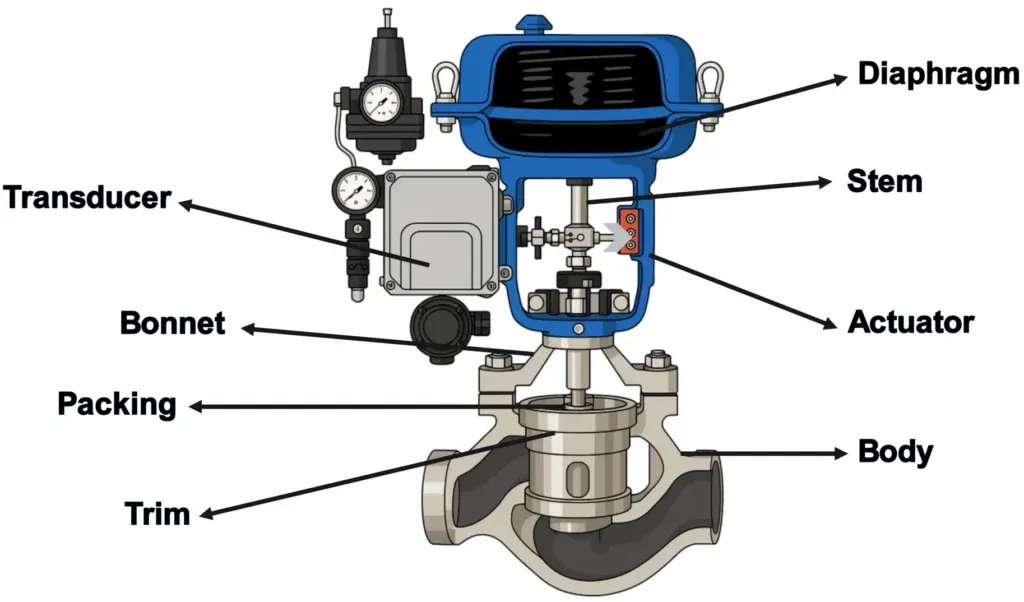
The most important concept to understand is that control valves are not isolation valves.
Isolation valves—such as gate valves, ball valves, and butterfly valves used for shut-off—are designed to either be fully open or fully closed. Their internal geometry prioritizes tight sealing, often using soft seats or high-contact sealing surfaces to achieve minimal or zero leakage.
Control valves, on the other hand, are designed for continuous modulation. Their primary function is to precisely control flow by adjusting the position of the valve plug relative to the seat. This requirement fundamentally shapes their internal design.
Key design priorities for control valves include:
- Stable throttling performance
- Accurate flow control across varying pressure drops
- Resistance to erosion and cavitation
- Predictable response to actuator movement
Because of these priorities, control valve seats and plugs are optimized for control accuracy rather than absolute tightness.
Internal leakage refers to the flow that passes through a control valve even when it is in the fully closed position. This leakage occurs at the interface between the valve plug and seat.
Even in a brand-new, properly installed control valve:
- Perfect metal-to-metal contact is nearly impossible
- Microscopic surface irregularities allow fluid to pass
- Thermal expansion, pressure forces, and mechanical tolerances all contribute to leakage
Importantly, internal leakage is not necessarily a defect. It is a measurable, allowable characteristic defined by industry standards.
Several factors influence the amount of leakage through a control valve:
Metal-seated valves rely on precision machining and controlled contact pressure. Even with advanced manufacturing, a small leakage path remains.
High pressure drop, flashing, cavitation, and particulate-laden fluids accelerate seat wear and increase leakage over time.
Thermal expansion and contraction can change clearances between the plug and seat, especially in high-temperature services such as steam.
The actuator must generate sufficient force to seat the plug tightly. In some cases, actuator sizing prioritizes modulation performance rather than maximum seating force.
To standardize expectations and eliminate ambiguity, control valve leakage is classified according to ANSI/FCI 70-2, one of the most widely recognized standards in the industry.
This standard defines six leakage classes, ranging from relatively high allowable leakage to extremely tight shut-off.
Class I – Least Tight Shut-Off
No specific leakage test required
Leakage determined by visual inspection
Typically used for non-critical applications
Class II
Allows higher leakage than Class IV
Rarely specified in modern process industries
Class III
Moderate leakage allowance
Suitable for non-critical services where tight shut-off is not essential
Class IV – Common Industrial Standard
Maximum leakage: 0.01% of rated valve capacity
Most widely used leakage class in chemical plants and refineries
Balances good control performance with acceptable shut-off
Class V – Tighter Metal Seat Performance
Much lower leakage than Class IV
Leakage measured using water at specified pressure
Still not zero leakage
Often specified for higher-pressure or hazardous services
Class VI – Bubble-Tight Shut-Off
Lowest allowable leakage
Measured in bubbles per minute using air or nitrogen
Achievable only with soft-seat designs
Typically limited to smaller valve sizes
Class VI leakage is often referred to as “bubble-tight”, but it comes with important limitations:
Requires elastomeric or PTFE seats
Limited temperature capability
Not suitable for steam or high-temperature hydrocarbons
Vulnerable to chemical attack and radiation exposure
As a result, Class VI valves are commonly used in:
Instrument air systems
Clean gas applications
Low-temperature, low-pressure services
For many industrial processes, Class IV or Class V represents a more practical and durable solution.
To verify compliance with leakage standards, control valve manufacturers conduct a series of leakage tests during production. In addition, periodic testing during service life helps assess valve condition and performance degradation.
As a general guideline:
Annual testing is recommended for most control valves
More frequent testing may be required for:
Severe service applications
Safety-critical processes
Valves exposed to erosion or corrosion
Testing intervals should ultimately be based on:
Valve service conditions
Historical performance
Plant maintenance strategy
Test Principle
The bubble test is used exclusively for Class VI seat leakage verification.
In this test:
The valve is closed and pressurized with air or nitrogen
The downstream side is submerged in water
Leakage is measured by counting bubbles escaping over time
Allowable Bubble Rates
According to ANSI/FCI 70-2:
For a 6-inch control valve, the maximum allowable leakage is 27 bubbles per minute
Smaller valves have lower allowable bubble rates
Larger valves are rarely specified for Class VI due to practicality limits
Advantages of the Bubble Test
Simple and visually intuitive
Highly sensitive to very small leakage rates
Ideal for soft-seated valve designs
Limitations of the Bubble Test
Despite its usefulness, the bubble test has notable constraints:
Limited to low-temperature applications
Soft seats cannot withstand high temperatures or steam
Not suitable for nuclear radiation environments
Not applicable to metal-seated valves
Test Description
In a hydrostatic leakage test, the valve is pressurized using a liquid medium such as:
Water
Kerosene
Other suitable test fluids
The valve is closed, and leakage past the seat is measured over a specified period.
Applications
Hydrostatic testing is commonly used for:
Class IV leakage verification
Class V leakage verification
High-pressure liquid services
Key Characteristics
More representative of real liquid service conditions
Allows precise measurement of leakage volume
Less compressibility compared to gas testing
Test Description
In a pneumatic test, the valve is pressurized using a gas such as:
Air
Nitrogen
Leakage is detected and measured using:
Flow meters
Pressure decay methods
Bubble observation (for Class VI)
Why Zero Leakage Is Unrealistic
With gas testing:
Gas molecules are much smaller than liquid molecules
Even minute clearances allow detectable leakage
Therefore, zero leakage is rarely achievable
Instead, standards define a Maximum Allowable Leakage (MAL).
The acceptable leakage rate depends on several variables:
1. Valve Size
Smaller valves have smaller effective orifices. A small amount of leakage through a small valve represents a higher percentage of flow capacity.
2. Pressure Differential
Higher test pressures increase leakage forces and measurement sensitivity.
3. Leakage Class
Each ANSI/FCI class defines its own MAL limits.
For example:
A leakage rate of 1 ml/min through a small valve may be unacceptable
The same leakage rate through a large valve may fall well within allowable limits
This is why leakage limits are normalized relative to valve capacity.
In many processes, small leakage has minimal impact:
Non-hazardous fluids
Bypass or blending applications
Temperature or pressure control loops
Leakage can be critical in:
Safety shutdown systems
Toxic or flammable fluid services
Energy efficiency-sensitive processes
Batch operations requiring strict isolation
In such cases, a separate isolation valve is often installed upstream or downstream of the control valve.
While leakage cannot be completely eliminated, it can be effectively managed through proper selection and maintenance.
Avoid over-specifying Class VI when it is not required. Instead:
Match leakage class to process needs
Consider long-term durability and service conditions
Metal seats for high temperature and erosive services
Soft seats for low-temperature, clean services requiring tight shut-off
Ensure sufficient seating force without compromising modulation performance.
Monitor leakage trends
Recondition seats and plugs when necessary
Replace worn components before leakage exceeds allowable limits
For applications requiring true shut-off:
Combine a control valve with a dedicated isolation valve
This approach preserves control performance while ensuring safety
Control valve leakage is a normal, measurable, and standardized characteristic of control valve operation. Unlike isolation valves, control valves are engineered for precise regulation rather than absolute shut-off, making a certain level of leakage unavoidable—even in new, properly installed valves.
By understanding ANSI/FCI leakage classes, testing methods, and practical limitations, engineers and plant operators can make informed decisions that balance performance, reliability, and safety. Proper valve selection, realistic leakage expectations, and proactive maintenance are the keys to managing leakage effectively across the valve’s service life.
Ultimately, control valve leakage should not be viewed as a flaw, but as an inherent design consideration—one that, when properly understood, contributes to safe, efficient, and predictable process control in modern industry.