
In modern hygienic processing industries, maintaining product purity, process efficiency, and regulatory compliance is not optional—it is fundamental. Industries such as food and beverage, dairy, pharmaceuticals, biotechnology, cosmetics, and fine chemicals all rely on sanitary-grade flow control equipment to ensure that fluids are transported, isolated, and controlled without contamination. Among the many valve types used in these demanding environments, sanitary pneumatic ball valves have become one of the most reliable and widely adopted solutions.
Sanitary pneumatic ball valves combine the hygienic advantages of sanitary ball valve construction with the speed, precision, and automation capability of pneumatic actuation. Designed to meet stringent sanitary standards, these valves feature smooth internal surfaces, minimal dead zones, and materials compatible with aggressive cleaning procedures such as CIP (Clean-in-Place) and SIP (Sterilize-in-Place). When paired with pneumatic actuators, they enable fast, repeatable, and remote operation—an essential requirement in automated production lines.
As production facilities continue to move toward higher automation, stricter hygiene regulations, and greater operational efficiency, sanitary pneumatic ball valves play an increasingly critical role. This article explores their design principles, classifications, connection types, advantages, applications, selection criteria, and future development trends, offering a comprehensive overview for engineers, plant managers, and procurement professionals.
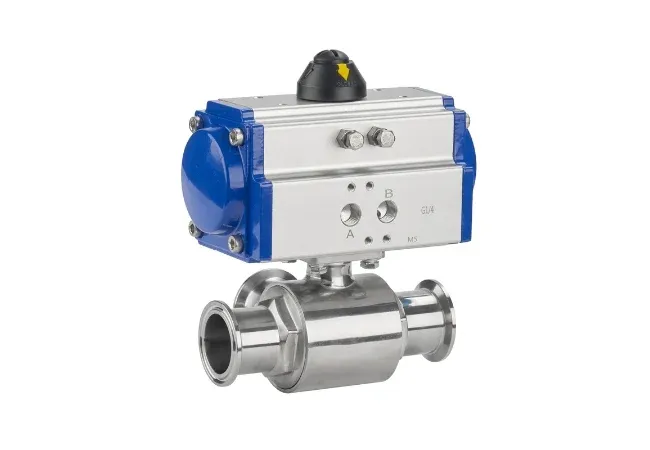
A sanitary pneumatic ball valve is a quarter-turn valve that uses a spherical ball with a bore through its center to control fluid flow. The ball rotates 90 degrees to open or close the valve, allowing for rapid shutoff and reliable sealing. In sanitary applications, the valve body, ball, and internal components are carefully designed to eliminate crevices, sharp corners, and dead spaces where bacteria or residue could accumulate.
The pneumatic actuator mounted on top of the valve converts compressed air energy into mechanical motion. This allows the valve to open or close automatically, either through simple on/off control or as part of a complex automated process. Pneumatic operation is particularly favored in hygienic industries because it is clean, safe, spark-free, and suitable for washdown environments.
Key features of sanitary pneumatic ball valves include polished internal surfaces (often Ra ≤ 0.8 μm or better), FDA- and USP-compliant sealing materials, corrosion-resistant stainless steel construction, and compatibility with international sanitary standards such as 3-A, EHEDG, ASME BPE, and ISO.
Selecting the right sanitary pneumatic ball valve begins with understanding the different types available. These valves can be categorized based on construction, port design, and connection type, each influencing performance, maintenance, and suitability for specific applications.
Three-piece sanitary ball valves are the most commonly used design in hygienic industries. As the name suggests, the valve body consists of three main components: two end caps and a central body section containing the ball and seats.
The primary advantage of this design is ease of maintenance. The central body can be removed or swung out while the end connections remain welded or clamped to the pipeline. This allows operators to inspect, clean, or replace internal components such as seats and seals without dismantling the entire system.
Three-piece valves are especially valuable in applications requiring frequent cleaning, validation, or product changeovers. They are well-suited for CIP/SIP processes and are often preferred in pharmaceutical, biotech, and high-end food processing facilities where downtime must be minimized.
Two-piece sanitary ball valves feature a simpler construction, typically consisting of a main body and one removable end connection. This design is more compact and often more economical compared to three-piece valves.
While two-piece valves offer reliable performance, they generally require complete removal from the pipeline for thorough cleaning or maintenance. As a result, they are more commonly used in less critical sanitary applications, utility lines, or systems where maintenance frequency is low.
In full port sanitary ball valves, the bore diameter of the ball matches the internal diameter of the pipeline. This creates a straight-through, unobstructed flow path with minimal turbulence and pressure drop.
Full port designs are ideal for handling viscous fluids, slurries, or products containing particulates, such as yogurt, syrups, sauces, creams, or pharmaceutical suspensions. They also facilitate effective CIP and pigging operations, ensuring complete product recovery and thorough cleaning.
Because of these advantages, full port sanitary pneumatic ball valves are often selected for high-purity and high-value product lines.
Standard port valves have a bore diameter smaller than the pipeline diameter, resulting in a more compact valve design. While this creates a slight flow restriction, it is acceptable in many applications involving low-viscosity fluids such as water, alcohol, or cleaning solutions.
Standard port valves are typically more cost-effective and lighter, making them suitable for space-constrained installations or non-critical sanitary services.
The connection method of a sanitary ball valve significantly impacts installation, maintenance, and cleanliness. The most common connection types include tri-clamp, weld ends, and threaded ends.
Tri-clamp connections are the most widely used connection type in sanitary piping systems. They consist of two ferrules, a gasket, and a clamp that secures the joint.
The main advantage of tri-clamp connections is their tool-free assembly and disassembly, which greatly simplifies cleaning, inspection, and maintenance. This makes them ideal for systems requiring frequent disassembly, such as pilot plants, flexible production lines, or facilities producing multiple products.
Tri-clamp sanitary pneumatic ball valves are extensively used in food, beverage, dairy, and pharmaceutical applications.
Weld end sanitary ball valves are permanently welded into the pipeline, creating a smooth, crevice-free flow path. This type of connection offers maximum hygiene and leak resistance, making it suitable for high-pressure, high-temperature, or critical sterile systems.
Welded valves are commonly used in pharmaceutical water systems, biotech fermentation lines, and sterile process environments where contamination risk must be minimized.
Threaded sanitary ball valves are less common in highly hygienic applications due to the potential for crevices and sealing challenges. However, they may still be used in utility lines, auxiliary systems, or semi-critical processes where full sanitary compliance is not required.
Pneumatic actuation is a key factor that elevates sanitary ball valves from manual components to intelligent process control devices. Pneumatic actuators can be configured as double-acting or spring-return (single-acting) types.
Double-acting actuators use compressed air to both open and close the valve, offering precise control and high torque output. Spring-return actuators use air to operate the valve in one direction, while an internal spring automatically returns it to a predefined fail-safe position (open or closed) in the event of air supply loss.
Pneumatic operation provides several advantages, including rapid response, consistent performance, and easy integration with automation systems such as PLCs and distributed control systems (DCS). Positioners, solenoid valves, and feedback devices can be added to enable remote monitoring and control.
Sanitary pneumatic ball valves offer numerous benefits that make them indispensable in hygienic processing environments.
First, they provide excellent sealing performance, ensuring reliable shutoff and preventing cross-contamination between product batches. High-quality seat materials such as PTFE, reinforced PTFE, or elastomers compliant with FDA and USP standards ensure long service life and chemical resistance.
Second, their fast quarter-turn operation allows for quick opening and closing, improving process efficiency and reducing cycle times. This is particularly important in high-speed production lines and automated systems.
Third, sanitary pneumatic ball valves are easy to clean and sterilize. Smooth internal surfaces, minimal dead zones, and compatibility with CIP/SIP processes ensure compliance with strict hygiene requirements.
Finally, pneumatic actuation enhances operator safety and process consistency by eliminating manual handling and reducing human error.
Sanitary pneumatic ball valves are widely used across a broad range of industries.
In the food and beverage industry, they control the flow of liquids such as milk, beer, juice, sauces, and edible oils. Their hygienic design ensures product safety and compliance with food safety standards.
In pharmaceutical and biotechnology applications, these valves are used in purified water systems, fermentation processes, buffer preparation, and sterile transfer lines, where cleanliness and reliability are paramount.
In the cosmetics and personal care industry, sanitary pneumatic ball valves handle creams, lotions, and liquid formulations without compromising product quality.
They are also increasingly used in fine chemical and specialty chemical processing, where contamination control and precise flow management are essential.
Choosing the right valve requires careful evaluation of several factors, including fluid characteristics, operating conditions, hygiene standards, and automation requirements.
Material selection is critical, with stainless steel grades such as AISI 304 and 316L being the most common choices due to their corrosion resistance and cleanability. Seal materials must be compatible with both the process fluid and cleaning agents.
Pressure and temperature ratings should match the operating conditions, while connection type and valve size must align with the piping system design.
Finally, the choice of pneumatic actuator—torque output, fail-safe function, and control accessories—should be tailored to the specific application.
As hygienic industries continue to evolve, sanitary pneumatic ball valves are also advancing. Manufacturers are focusing on improved surface finishes, enhanced sealing materials, and smarter actuation systems.
Integration with digital monitoring and Industry 4.0 platforms is becoming more common, allowing real-time valve status monitoring, predictive maintenance, and improved process control.
Sustainability is another emerging trend, with increased emphasis on energy-efficient actuators, longer service life, and materials that reduce environmental impact.
Sanitary pneumatic ball valves have become a cornerstone of modern hygienic processing systems. By combining clean, reliable valve design with efficient pneumatic automation, they meet the demanding requirements of today’s food, pharmaceutical, biotech, and cosmetic industries.
Their versatility, ease of maintenance, and compliance with international sanitary standards make them an ideal choice for both new installations and system upgrades. As automation and hygiene requirements continue to rise, sanitary pneumatic ball valves will remain a vital component in ensuring safe, efficient, and compliant production processes.