
Modern industries increasingly depend on equipment capable of handling complex, abrasive, and high-solid media without sacrificing reliability or efficiency. From wastewater treatment and mining operations to chemical processing and power generation, systems are expected to manage thick slurries, fibrous materials, powders, and corrosive fluids under demanding conditions. Traditional gate, globe, or butterfly valves often struggle in such environments due to clogging, excessive wear, or slow response.
To meet these challenges, engineers are turning to the cast steel pneumatic knife gate valve—a specialized flow-control solution designed to cut through solids, maintain smooth flow, and deliver fast, automated operation. By combining the mechanical strength of cast steel with the speed and precision of pneumatic actuation, this valve type has become an essential component in industries where reliability and low maintenance are critical.
This article explores the structure, working principle, features, applications, and advantages of cast steel pneumatic knife gate valves, highlighting why they are increasingly adopted in modern industrial systems.
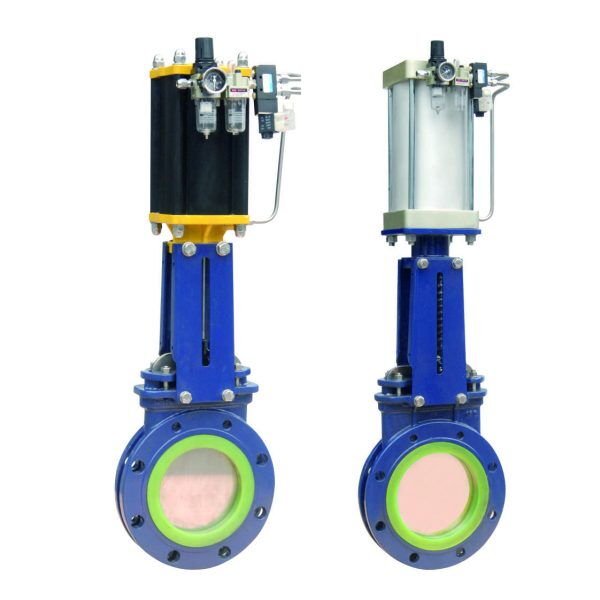
A knife gate valve is a linear-motion valve designed primarily for on/off and isolation service in pipelines that carry fluids with high solid content. Unlike conventional gate valves that rely on thick wedge-shaped gates, knife gate valves feature a thin, sharp-edged blade. This blade moves perpendicular to the flow, slicing through media that may contain fibers, sludge, powder, or suspended particles.
The “knife” design allows the valve to:
Cut through viscous and semi-solid materials
Prevent accumulation of debris at the sealing surfaces
Minimize blockage in demanding process lines
The choice of cast steel for the valve body offers key advantages:
High mechanical strength to withstand pressure, impact, and vibration
Excellent durability in abrasive and high-temperature environments
Compatibility with industrial piping standards, enabling easy integration
Cast steel bodies are particularly suited for heavy-duty applications where lightweight materials or plastics may fail under continuous stress.
In a pneumatic knife gate valve, the blade is driven by compressed air through a pneumatic actuator mounted on top of the valve. When air is supplied to the actuator, it moves a piston that raises or lowers the blade, opening or closing the valve.
Depending on system requirements, configurations may include:
- Single-acting actuators (spring return for fail-safe operation)
- Double-acting actuators (air supplied for both opening and closing)
- Normally closed (NC) or normally open (NO) designs
This allows operators to choose the appropriate safety and control logic for their processes.
Pneumatic actuation offers several operational benefits:
- Fast response time, ideal for automated production lines
- Low noise operation, improving workplace conditions
- Simple structure, reducing maintenance complexity
- Intrinsic safety, especially in explosive or hazardous environments
Compared to electric actuators, pneumatic systems are often preferred in dusty, wet, or chemically aggressive areas where electrical equipment may be vulnerable.
One of the defining characteristics of modern cast steel pneumatic knife gate valves is their compact size and relatively light weight compared with traditional heavy-duty isolation valves. This streamlined design enables:
- Installation in tight or confined spaces
- Reduced load on pipe supports
- Simplified handling during installation and maintenance
Despite their compact footprint, these valves maintain the structural integrity required for demanding applications.
The blade gate is precision-machined with a sharp leading edge that cuts through solid-laden media. As it moves:
Deposits are cleared from the sealing area
Material buildup is minimized
Flow paths remain unobstructed
This “self-cleaning” action is a major advantage in pipelines carrying sludge, pulp, or particulate matter.
To ensure leak-tight performance in corrosive or chemically aggressive environments, cast steel pneumatic knife gate valves are often equipped with advanced sealing materials:
PTFE (Polytetrafluoroethylene): Excellent chemical resistance, low friction, suitable for acids, alkalis, and solvents
PPL (Polypropylene): High resistance to corrosion, lightweight, and suitable for a wide range of industrial fluids
These seals maintain performance even in harsh media, reducing the risk of leakage and extending service life.
Valves are typically designed with flanges that comply with major international standards, allowing easy connection to existing pipelines. This standardization simplifies:
Installation and replacement
Integration into global projects
Maintenance and system upgrades
Cast steel pneumatic knife gate valves can be installed in both horizontal and vertical pipelines without compromising performance. This flexibility is especially valuable in retrofitting projects or compact plant layouts where pipe routing is constrained.
Another advantage lies in simplified maintenance procedures. The valve design allows:
- Quick access to internal components
- Replacement of seals without specialized tools
- Reduced downtime during inspections or repairs
This maintenance-friendly structure directly contributes to lower operating costs over the valve’s lifecycle.
To meet diverse operational requirements, these valves support multiple control configurations:
- Single-acting or double-acting actuators
- Normally open or normally closed positions
- Manual override options for emergency operation
This versatility ensures compatibility with both simple systems and fully automated industrial plants.
Modern cast steel pneumatic knife gate valves can be equipped with a wide range of accessories, including:
- Solenoid valves for automated air control
- Limit switches to provide open/close position feedback
- Filters and regulators to ensure clean, stable air supply
- Positioners for precise blade control and partial opening
- Manual levers and locking devices for safety and maintenance
With these additions, the valve becomes part of an intelligent control network, enabling remote operation, monitoring, and integration into SCADA or DCS systems.
In wastewater treatment plants, valves must handle thick sludge, fibrous materials, and abrasive particles. Traditional valves often clog or suffer from excessive wear. Knife gate valves, however:
Slice through solids without obstruction
Resist corrosion from aggressive chemicals
Maintain reliable shut-off in sludge-handling lines
This makes them ideal for inlet channels, sludge transfer pipelines, and dewatering systems.
Paper mills rely on the controlled movement of pulp, fibers, and process water. Cast steel pneumatic knife gate valves:
Separate pulp streams efficiently
Prevent fiber accumulation at sealing surfaces
Ensure smooth operation in high-solid-content pipelines
Their fast actuation supports automated production cycles and improves line efficiency.
In mining operations, pipelines often transport ore slurry, tailings, and abrasive materials. The rugged design of cast steel knife gate valves enables them to:
Withstand abrasive wear
Operate reliably in dusty and harsh environments
Maintain isolation performance in heavy-duty slurry lines
These properties reduce maintenance frequency and enhance operational continuity.
Chemical processes frequently involve corrosive, high-temperature, or hazardous fluids. With PTFE or PPL sealing and cast steel bodies, these valves:
Resist chemical attack
Support safe isolation of process lines
Enable integration into automated safety systems
Pneumatic actuation further ensures rapid response during emergency shutdowns.
In coal-fired or biomass power plants, systems transport ash, coal dust, and other particulate media. Knife gate valves are used to:
Control ash removal lines
Isolate fuel handling systems
Maintain reliability under continuous operation
Their ability to cut through solid-laden flow prevents clogging and ensures consistent plant performance.
Even in hygienic or precision-oriented industries, certain processes involve powders, granules, or semi-solid materials. Properly specified knife gate valves:
Support clean-in-place (CIP) operations
Provide consistent isolation
Reduce contamination risks through effective sealing
Unlike conventional valves, knife gate designs excel at cutting through thick solids, fibrous materials, and viscous liquids. This capability ensures reliable operation even when media properties fluctuate.
Pneumatic drives enable rapid opening and closing, supporting automated process control. Their quiet operation also improves working environments in manufacturing facilities.
Standardized flange dimensions simplify installation and replacement across different projects and regions, reducing engineering time and ensuring compatibility with global piping systems.
Optional positioners and sensors allow for:
Remote monitoring
Partial opening for flow regulation
Integration with digital control platforms
This transforms the valve from a simple isolation device into an intelligent control component.
With competitive pricing, reduced installation time, and lower maintenance requirements, cast steel pneumatic knife gate valves offer an excellent balance between performance and lifecycle cost.
The use of advanced sealing materials such as PTFE and PPL ensures:
Long-term resistance to corrosion
Stable sealing under temperature and pressure variations
Reduced risk of leakage in hazardous environments
Single-acting pneumatic actuators can be configured for fail-closed or fail-open operation. In the event of air supply loss, the valve automatically returns to a safe position, enhancing system safety.
Cast steel construction provides resistance to:
Mechanical shock
Vibration
Abrasion from solid particles
This durability is essential for applications such as mining, power generation, and chemical processing.
Knife gate valves handle solids and slurry more effectively.
Traditional gate valves may jam or wear quickly in similar conditions.
Knife gate valves provide better isolation in pipelines with heavy solids.
Butterfly valves are more suitable for clean fluids and throttling applications.
Ball valves offer tight sealing for clean fluids but struggle with abrasive or fibrous media.
Knife gate valves maintain performance in challenging flow conditions.
Self-cleaning blade action and robust design reduce clogging and failure, minimizing unplanned shutdowns.
Simplified structure and durable materials extend service intervals, reducing spare parts and labor requirements.
Fast actuation and optional automation enhance control accuracy and responsiveness, improving overall plant productivity.
The adoption of smart positioners, digital sensors, and remote monitoring is expanding the role of knife gate valves in intelligent manufacturing environments.
Ongoing development in alloys and sealing compounds is further improving resistance to abrasion, temperature extremes, and chemical exposure.
By reducing leaks, minimizing waste, and supporting efficient material handling, modern knife gate valves contribute to energy efficiency and environmental protection in industrial operations.
The cast steel pneumatic knife gate valve has become a cornerstone of modern industrial flow control where solids, slurries, and abrasive materials are involved. Combining rugged mechanical construction with fast, reliable pneumatic actuation, it delivers performance that traditional valve types struggle to achieve.
From wastewater treatment and mining to chemical processing, power generation, and advanced manufacturing, this valve design offers unmatched versatility, durability, and cost-effectiveness. Its compact form, self-cleaning blade, corrosion-resistant sealing, and wide range of control options make it an ideal solution for both new installations and system upgrades.
As industries continue to demand higher efficiency, automation, and reliability, the cast steel pneumatic knife gate valve stands out as a practical and future-ready choice for challenging flow-control applications.
