
Across modern industrial sectors, achieving safe, efficient, and automated control of fluid and gas systems is essential for maintaining productivity and ensuring operational safety. Pneumatic actuated valves play a critical role in this landscape, offering robust performance and rapid response for a wide range of applications. Among them, the pneumatic actuated butterfly valve has emerged as one of the most versatile, cost-effective, and widely adopted valve types used for remote and automated flow regulation.
This news article takes an in-depth look at the design, working principles, applications, advantages, and maintenance practices of pneumatic actuated butterfly valves. As industries continue to evolve toward higher levels of automation and digital control, these valves remain fundamental components in pipelines and process systems across chemical processing, water treatment, food and beverage production, energy infrastructure, HVAC operations, and many other environments. Their simplicity, reliability, and adaptability make them a preferred choice for engineers, operators, and maintenance professionals around the world.
A pneumatic actuated butterfly valve is a flow-control device powered by compressed air. At its core, it consists of two critical components:
1. Butterfly Valve Body with Rotating Disc
2. Pneumatic Actuator Mounted on Top
When compressed air enters the actuator, it generates motion that rotates the valve disc by 90 degrees. This rotation either opens, closes, or modulates the flow of liquid or gas through the pipeline. Because air-powered actuators respond quickly and provide strong torque output, they are ideal for systems requiring high-speed actuation or frequent cycling.
Pneumatic actuated butterfly valves are favored for several reasons:
They are simple in structure yet extremely reliable.
They are safe for use in hazardous or flammable environments, since no electricity is required.
They provide excellent durability under continuous operation.
They offer an attractive cost advantage, especially for larger valve sizes.
Due to these strengths, industries ranging from chemical, pharmaceutical, petrochemical, wastewater treatment, food and beverage, oil and gas, bulk powder handling, and HVAC rely on pneumatic butterfly valves for daily operation.
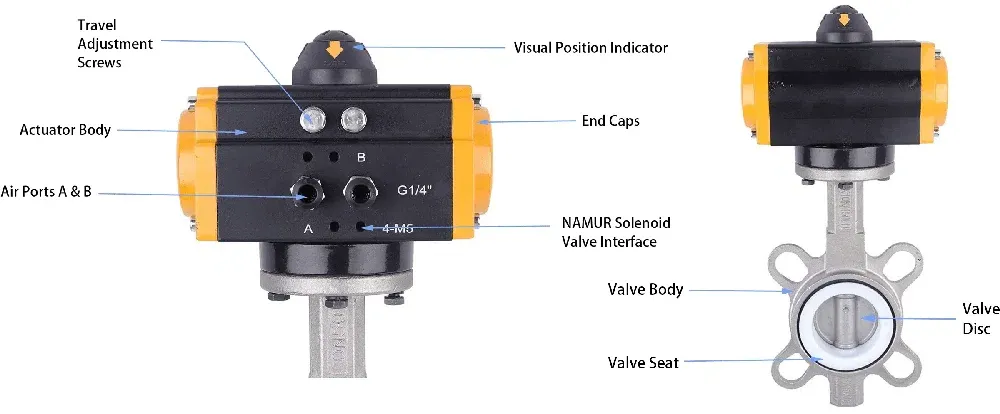
A pneumatic actuated butterfly valve may come with either lug or wafer body styles, each suited for different installation requirements:
Designed to fit between two flanges
Held in place by flange bolts that surround the valve body
Lightweight and cost-effective
Commonly used in systems that do not require the pipeline to be disconnected on both sides simultaneously
Equipped with threaded lugs surrounding the valve body
Allows one side of the piping system to be disconnected without disturbing the other
Offers greater installation flexibility and isolation capability
Preferred in applications where regular line maintenance is required
Both types offer dependable flow control and are compatible with standard flange specifications, offering engineers flexibility in system design.
Pneumatic actuators use compressed air—typically between 4 to 8 bar (60 to 120 psi)—to generate the mechanical torque needed to rotate the valve disc. The two primary actuator types are single-acting (spring return) and double-acting.
A single-acting actuator operates using one air inlet and an internal spring.
Compressed air enters the actuator to rotate the disc to the open or closed position.
When air pressure is removed, the internal spring automatically returns the valve to its default position.
This default state is configured as either:
Fail-Open (disc returns to open position)
Fail-Close (disc returns to closed position)
Built-in safety mechanism
Provides automatic fail-safe operation during air or power loss
Ideal for emergency shutdown systems
Lower air consumption compared to double-acting models
Reliable in remote or unmanned installations
Emergency shutdown lines
High-risk installations in chemical plants
Water/air supply systems requiring automatic safe positioning
Systems requiring a quick response in failure scenarios
Single-acting pneumatic actuators are often preferred when safety and reliability under unexpected conditions are critical.
A double-acting pneumatic actuator uses two air inlets, providing air power for both opening and closing actions.
First air signal: Opens the disc
Second air signal: Closes the disc
No internal spring is used—air pressure alone controls both movements
Stronger torque output
Faster actuation speeds
Wider control range
Longer service life due to reduced internal mechanical stress
Provides precise control, making it suitable for automated modulation
High-pressure or high-flow pipelines
Industrial processes requiring frequent cycling
Actuation of large butterfly valves where torque requirements are high
Process systems requiring fast open/close sequences
Double-acting actuators are commonly used when performance, precision, and endurance are top priorities.
Pneumatic actuators have fewer failure points compared to electric actuators. They operate safely even in extreme temperatures or corrosive atmospheres and are resistant to overload conditions.
For sizes above 8 inches, pneumatic actuators are significantly more economical than electric actuators. They offer the best torque-to-cost ratio in the valve industry.
Compressed air enables quick response times, making pneumatic valves suitable for applications requiring instant action—such as safety systems or automated production lines.
Since they rely on air pressure rather than electric motors, pneumatic valves are inherently safe in explosive environments such as oil refineries and chemical processing facilities.
The design is simple, with fewer moving parts, resulting in lower maintenance costs and longer operational life.
Pneumatic actuated butterfly valves are used extensively across several sectors due to their versatility:
Acid/alkali pipelines
Process gas control
Solvent processing units
Their corrosion-resistant bodies and high torque capabilities ensure safe, stable control.
Pumping station flow regulation
Sludge handling
Disinfection systems
Light movement and reliable sealing make them suitable for continuous operations in these facilities.
Beverage mixing lines
Sanitary fluid handling
Clean-in-place (CIP) systems
Stainless-steel options ensure hygiene and compliance with sanitary requirements.
Purified water distribution
Solvent flow systems
Sterile production environments
High-precision control and contamination resistance are essential in these applications.
Air handling
Cooling water control
Chilled water circuits
Low pressure drops and fast response times support large building automation systems.
Power Generation
Cooling towers
Boiler feed systems
Chemical dosing stations
Long life and vibration resistance support demanding power plant operations.
Modern pneumatic actuated butterfly valves can be configured with a variety of materials to suit the application:
Cast iron
Ductile iron
Stainless steel (304, 316)
Aluminum bronze
Duplex stainless steel
Stainless steel
Nickel-plated discs
PTFE-coated discs for corrosive fluids
EPDM
NBR
VITON
PTFE
Silicone
Selecting the right material ensures compatibility with chemicals, temperature ranges, and pressure conditions.
With the expansion of smart factory systems, pneumatic butterfly valves can be equipped with:
Positioners for precise throttling
Solenoid valves for directional air control
Limit switches for open/closed feedback
Air filter regulators for clean and stable airflow
Smart controllers for integration into SCADA or PLC systems
This makes them suitable for Industry 4.0 environments.
Proper maintenance ensures long-term reliability and reduces the risk of unnecessary downtime. Essential practices include:
Check for air leaks or loose fittings
Inspect actuator seals and O-rings
Ensure disc and seat remain free of debris
Verify limit switch and solenoid wiring
Lubricate stem bearings and actuator moving parts
Prevents premature wear and friction
Perform full-stroke tests and partial-stroke tests
Verify opening/closing speed
Ensure fail-safe position works correctly
Actuator not moving: Check air supply and solenoid valve
Leakage at stem: Replace worn seals
Valve not sealing: Inspect disc and seat for damage
Slow operation: Check for insufficient air pressure
Implementing a preventive maintenance schedule—based on valve size, operating frequency, and environmental conditions—can greatly extend the service life of both valve and actuator.
The pneumatic actuated butterfly valve continues to be a cornerstone of industrial automation due to its reliability, efficiency, and adaptability. Whether in large-scale chemical processing, water treatment infrastructure, food production lines, or sophisticated HVAC systems, these valves deliver dependable performance while keeping operating costs manageable.
Their ability to provide rapid response, high torque output, safe fail-safe positioning, and compatibility with modern automation technologies ensures that they remain a vital component in fluid and gas handling systems. As industries evolve toward higher levels of efficiency and automation, the pneumatic actuated butterfly valve will continue to play a crucial role in maintaining safe, precise, and productive operations across countless industrial sectors.